
Introduction
When Mach number, that is the ratio between flow velocity and sound speed, is over approximately 0.3, compressibility of fluid must be considered.
Following article provides an overview of the Mach number.
In compressible flow, the condition where the Mach number reaches 1 is called as “choking” or “choked flow”.
There are two key advantages to choked flow.
First, the mass flow rate can be easily calculated using the cross-sectional area at the throat, the upstream (tank) pressure and temperature, and the specific gas properties.
\( m = \dfrac{P_0A}{\sqrt{RT_0}}\sqrt{γ(\dfrac{2}{γ+1})^{\frac{γ+1}{γ-1}}} \)
Second, a constant flow rate can be maintained regardless of changes in backpressure.
This article provides an overview of the choked flow.
Relationship between cross-sectional areas and flow velocity
Now, let’s imagine air flowing through a rubber hose.
If you pinch the outlet to decrease the cross-sectional area, the air gushes out at a higher velocity.
This principle can be confirmed by the mass flow rate equation below.
Assuming the mass flow rate and density are constant, the smaller the cross-sectional area becomes, the higher the flow velocity gets.
\( m = ρAu \)
Now, what happens if we make the cross-sectional area even smaller?
Well then, let’s examine the equation relating cross-sectional area and flow velocity, taking compressibility into account.
This equation is derived from the conservation of mass and momentum, assuming an ideal gas and isentropic flow. If you are interested in the details, I recommend checking out the references at the bottom of this article!
\( (1-M^2) \dfrac{du}{u} + \dfrac{dA}{A} = 0 \)
As you can see, the flow characteristics change drastically depending on the Mach number.
Subsonic flow (0 < M < 1)
When the cross-sectional area decreases (dA < 0), the flow velocity increases (du > 0).
This is identical to the rubber hose example and aligns with our intuition.
Supersonic flow(1 < M)
In this regime, when the cross-sectional area decreases (dA < 0), the flow velocity also decreases (du < 0). This contradicts our intuition.
In other words, in order to increase the flow velocity in a supersonic flow, the cross-sectional area must be increased.
Sonic flow(M = 1)
This is a special regime. When the gradient of the cross-sectional area is 0—in other words, where the cross-sectional area reaches its minimum (the throat)—the flow velocity reaches the speed of sound.
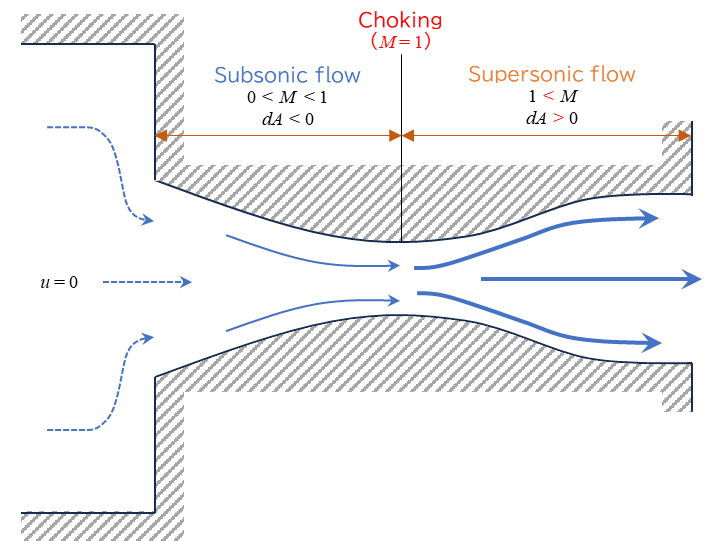
The figure below illustrates the flow characteristics described above.
Imagine a reservoir, such as a tank, where the flow velocity is zero.
As the cross-sectional area decreases, the flow velocity increases until it finally reaches the speed of sound. This position is known as the “choking point” or the “nozzle throat.
Downstream of the point,if the pipe diameter expands, the flow accelerates further1, and become supersonic. This system is called “De Laval nozzle”.
On the other hand, most industrial nozzles are convergent nozzles. In these cases, the flow velocity reaches the speed of sound at nozzle outlet.2
Critical pressure ratio and choked flow
As shown in the figure above, if the pressure difference between the tank pressure and the backpressure is sufficiently small, the flow will be minimal (or will not occur).
As the pressure difference increases gradually, and the flow eventually reaches the choked state, the ratio between the tank pressure and backpressure is known as the “Critical pressure ratio”.
The critical pressure ratio is determined by the specific heat ratio as shown in the formula below.
For an ideal gas (specifically air), a specific heat ratio of 1.4 is typically used. In this case, the critical pressure ratio is 0.528.
\(\dfrac{P_e}{P_0} = (\dfrac{2}{γ+1})^{\frac{γ}{γ-1}}\)
Therefore, if the tank pressure is approximately double the backpressure, the flow reaches sonic speed at the narrowest point (the throat).
Furthermore, even if the tank pressure increases or the backpressure decreases further, the location of the choked point remains unchanged, and the flow velocity at the throat is equal to the speed of sound.
Equation for mass flow rate
Once the flow reaches choked state, we can calculate the mass flow rate easily, because the flow velocity and cross-sectional area at the throat are constant.
However, since the density changes depending on the pressure in a compressible flow, the equation is more complex than the one used for incompressible fluids.
\( m = \dfrac{P_0A}{\sqrt{RT_0}}\sqrt{γ(\dfrac{2}{γ+1})^{\frac{γ+1}{γ-1}}} \)
where:
\(R \text{:Specific gas constant}\rm{[J/(kg・K)]} \) (The value obtained by dividing the universal gas constant by the molecular weight of the gas)
\(T_0 \text{:Total temperature of the gas}\rm{[K]} \)
As shown, if throat diameter, the upstream (tank) pressure and temperature, and the specific gas properties are known, the mass flow rate through the nozzle can be calculated without measuring the flow velocity. These principles also apply to orifice plates.
Effects of the speed of sounds and backpressure
Finally, let me summarize the effects of the speed of sound and backpressure.
Generally, the turbulence of the flow (Disturbance) propagates all directions as a pressure wave.
For example, when the laminar flow is accelerated, a disturbance may occur at some point downstream. This disturbance then propagates upstream as a pressure wave, which can cause the flow to transition into a turbulent state.
The pressure wave propagates at the speed of sound. Therefore, if the flow is at a sonic or supersonic state, the pressure wave cannot propagate upstream.
In other words, the upstream flow isn’t affected by downstream disturbances. This is the significant practical advantage.
For example, imagine fuel being injected into an engine cylinder.
The pressure inside the cylinder constantly fluctuates due to the flow and combustion.
Under these conditions, if the fuel is injected in choked state, the mass flow rate remains constant regardless of the cylinder pressure, making it much easier to control.
Conclusion
Did you find this article helpful?
We hope it provides a clearer understanding for those who find compressible flow challenging.
For more detailed information and derivation methods, please refer to the following references.
コメント